MoCRA Requirements for Foreign Cosmetic Brands

MoCRA is the U.S. cosmetics law that requires manufacturing facilities to register with the FDA, and requires the responsible person for each product to list it, keep safety records, and report serious adverse events. It covers cosmetics sold in the United States, including products made abroad. Certain small businesses are exempt.
This guide is written for brand owners and manufacturers outside the United States. It explains each MoCRA rule in plain English and links the rule to the FDA page that describes it. FDA guidance documents describe the agency's current thinking and are not legal advice, so confirm how the rules apply to your company with a regulatory specialist.
MoCRA at a Glance
Requirement | Who is responsible | Timing |
Facility registration | The owner or operator of each facility that manufactures or processes cosmetics | Renew every two years. Update within 60 days of a change |
Product listing | The responsible person | List a new product within 120 days of marketing it. Update each listing annually |
Safety substantiation | The responsible person | Keep records that support the safety of each product |
Serious adverse event reports | The responsible person | Report to the FDA within 15 business days |
What Is MoCRA?
The Modernization of Cosmetics Regulation Act of 2022 (MoCRA) became law on December 29, 2022. The FDA calls it the most significant expansion of its authority to regulate cosmetics since the Federal Food, Drug, and Cosmetic Act was passed in 1938. The FDA describes the act on its MoCRA page.
The act added new duties for cosmetic companies and new powers for the FDA, including access to certain records and the authority to order a mandatory recall. The FDA ended its voluntary cosmetic registration program on March 27, 2023, and does not treat earlier submissions to that program as meeting the new requirements.
Does MoCRA Apply to Foreign Cosmetic Brands?
Yes, when the products are distributed in the United States. The act defines a facility as any establishment that manufactures or processes cosmetic products distributed in the United States, and that includes an establishment of an importer. The FDA's guidance on registration and listing states that a contract manufacturer outside the United States must register if it makes products for U.S. distribution. Following ISO 22716 does not exempt a facility from registration.
The guidance says an establishment that only labels, relabels, packages, repackages, holds, or distributes cosmetic products is not a facility. Filling a container with a product does not count as packaging for this purpose.
Do Foreign Cosmetic Brands Need a U.S. Responsible Person?
No. The FDA says a company outside the United States can be the responsible person, as long as it is the manufacturer, packer, or distributor whose name appears on the product label. The law does not require the responsible person to be based in the U.S.
Two related rules do involve a U.S. presence:
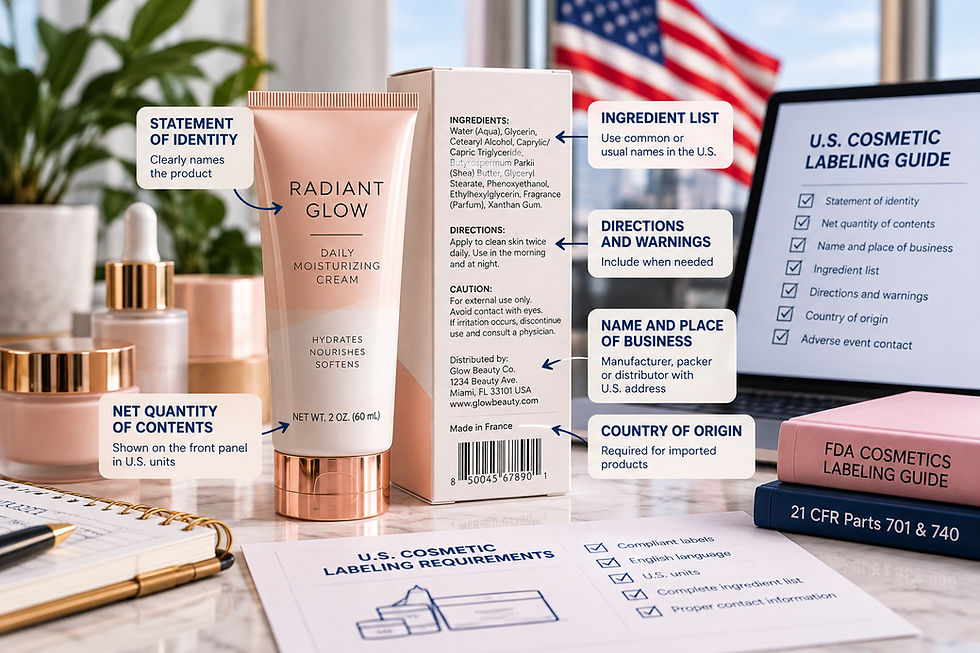
Label contact: each cosmetic label must include a domestic address, a domestic phone number, or electronic contact information, such as a website, where the responsible person can receive adverse event reports. The FDA recommends a contact that makes reporting easy, and says a fax number or QR code is unlikely to do that.
U.S. agent: a foreign facility must name a U.S. agent when it registers. The agent is a person or business that resides in the U.S. or keeps a U.S. place of business, and is physically present there. A mailbox or answering service does not qualify.
The responsible person is whoever is named on the label, so the answer differs by brand. It can be the brand owner, a contract manufacturer, or a distributor, if that company's name is on the label. A consultant can serve as the responsible person only if the consultant meets that same definition.
Requirement 1: Facility Registration
Manufacturers and processors must register each facility with the FDA. The FDA's registration and listing page and its guidance explain how:
Get an FDA Establishment Identifier (FEI) first. The FDA uses the FEI as the facility registration number, and the facility address must match the FEI record.
Submit the registration through the FDA's Cosmetics Direct portal, through the Electronic Submissions Gateway, or on paper using Form FDA 5066. The FDA encourages electronic submission. There is no fee.
For a foreign facility, include the U.S. agent's name and phone number, and an email address if available.
Renew every two years from the initial registration date. If nothing has changed, the FDA offers an abbreviated renewal.
Update the registration within 60 days of any change to the information.
A contract manufacturer needs only one registration, even if it makes products for several brands, and a responsible person whose products are made there may submit it. A facility that only stores products does not register.
The FDA states that it does not issue certificates or other documents to verify that a facility is registered. A registration number does not mean the FDA has approved the facility or its products.
Requirement 2: Product Listing
The responsible person must list each marketed cosmetic product with the FDA, including its ingredients, and update the listing every year. A new product must be listed within 120 days of marketing it, and a discontinued product is reported as an update.
A listing includes the facility registration number for each facility that makes the product, the name and contact number of the responsible person, the product name as it appears on the label, the product category, and the ingredient list. A single listing can cover products whose formulas are identical or differ only in color, fragrance, flavor, or quantity.
FDA says free samples and gifts need a listing too, with limited exceptions for samples used inside the industry for research and development. Listing is not approval of the product. There is no fee.
Requirement 3: Safety Substantiation
The responsible person must ensure, and keep records showing, that each cosmetic product is adequately substantiated for safety. The FDA's MoCRA page makes four points about this duty:
Neither the law nor FDA regulations require specific tests for individual products or ingredients.
A manufacturer can use relevant safety data that already exists.
Animal testing is not required to market a cosmetic.
The data should come from scientifically robust methods.
The FDA can access and copy certain records related to a cosmetic product, including safety records, if conditions are met.
Requirement 4: Adverse Event Reporting
A responsible person must report serious adverse events associated with use of a cosmetic in the United States to the FDA within 15 business days, and include a copy of the product label. If new medical information about the event arrives within one year of the first report, the responsible person must send it to the FDA within 15 business days.
The FDA defines a serious adverse event as one that results in outcomes such as death, a life-threatening experience, inpatient hospitalization, significant disability, a birth defect, an infection, or significant disfigurement, or that needs medical or surgical intervention to prevent those outcomes. Set up a complaint process before launch so these reports reach the right person.
Who Is Exempt From MoCRA Registration and Listing?
MoCRA exempts certain small businesses from good manufacturing practice, registration, and product listing requirements. The FDA's guidance defines a small business as a responsible person, owner, or operator whose average gross annual U.S. sales of cosmetic products over the previous three years are less than $1,000,000, adjusted for inflation.
The exemption does not apply to a business that makes or processes these products, whatever its sales:
Products that regularly come into contact with the mucous membrane of the eye, such as eye shadow or false eyelash adhesive
Injected products
Products intended for internal use
Products intended to alter appearance for more than 24 hours, where removal by the consumer is not part of normal use
The FDA does not issue small business exemption certificates. Products that are also drugs follow separate drug rules.
What the FDA Is Still Developing
MoCRA directs the FDA to establish regulations for good manufacturing practice at cosmetic facilities and for fragrance allergen labeling. Check the FDA's MoCRA page before you finalize labels and manufacturing procedures, because the status of these rules can change.
How to Prepare Early
List every facility that makes, fills, or processes your products, including contract manufacturers.
Decide which company's name will appear on each label, because that company is the responsible person.
Name a U.S. agent for each foreign facility, and request an FEI.
Gather ingredient lists and safety records for every product.
Set the label contact and a process for receiving and reporting adverse events.
Agree in writing with your distributor who submits registrations and listings and who keeps records.
Working With a U.S. Distribution Partner
A distributor whose name appears on a label can be the responsible person for that product. If the distributor does not appear on the label, the duties stay with the company that does. Because the roles can differ by product, decide who holds each duty before the first shipment and put the answer in the distribution agreement.
Partnering With Samtastic
Samtastic is a U.S. beauty distribution company that works in haircare, skincare, fragrance, and cosmetics. It is looking to work with brands, manufacturers, and suppliers that want U.S. distribution. Brands can review the categories Samtastic works in on the portfolio page.
If you are preparing for the U.S. market, raise regulatory roles early in any distribution conversation. Introduce your brand to Samtastic through the contact page, with your category, your country, and your product catalog.
Frequently Asked Questions
Do foreign cosmetic brands need a U.S. responsible person?
No. The FDA says a company outside the U.S. can be the responsible person if it is the manufacturer, packer, or distributor named on the label. The label must still carry a domestic address, domestic phone number, or electronic contact for adverse event reports, and a foreign facility must name a U.S. agent when it registers.
What does MoCRA require?
MoCRA requires facility registration, product listing, safety substantiation records, and serious adverse event reporting. It also gives the FDA new powers, including records access and mandatory recall authority. Certain small businesses are exempt from registration and listing.
How do I register a cosmetic facility with the FDA?
Obtain an FEI number, then submit the registration through Cosmetics Direct, the Electronic Submissions Gateway, or Form FDA 5066. A foreign facility must include a U.S. agent. Registration is free and must be renewed every two years.
Do small cosmetic brands have to register and list products?
Not if they qualify as a small business. The FDA's guidance sets the threshold at average gross annual U.S. cosmetic sales below $1,000,000, adjusted for inflation, over the previous three years. Businesses that make eye-area, injected, internal-use, or long-lasting products are not exempt.
Comments