Cosmetic Labeling Requirements for Selling in the U.S.
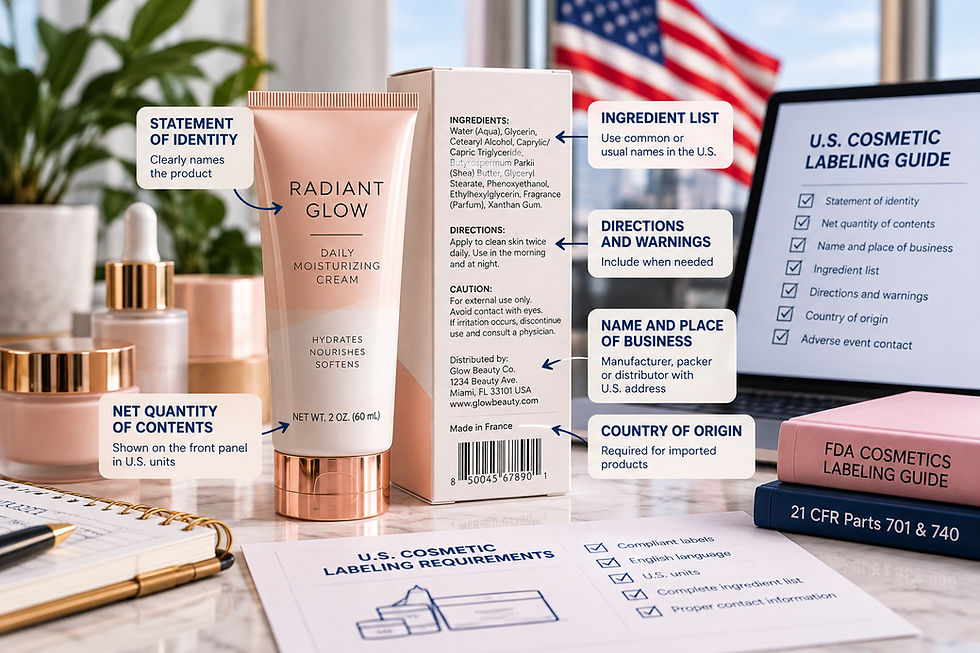
A U.S. cosmetic label must show a statement of identity and the net quantity of contents on the principal display panel. It must also show the name and place of business, an ingredient list, and any needed directions and warnings, all in English. The FDA does not pre-approve cosmetic labels, so the brand or its distributor must check them.
This guide is written for brand owners and manufacturers outside the United States. It explains what the FDA requires and which points to check on a label made for another market. The rules below come from the FDA's Cosmetic Labeling Guide or its labeling regulations page, unless noted. The rules are in 21 CFR parts 701 and 740. Confirm your labels with a regulatory specialist before printing.
What Must a Cosmetic Label Include in the U.S.?
Label item | Where it goes | Key rule |
Statement of identity | Principal display panel | Names the product by a common, descriptive, or fanciful name, or by an illustration. Bold type |
Net quantity of contents | Principal display panel | Stated in weight, measure, or count, using U.S. units |
Name and place of business | Information panel | Manufacturer, packer, or distributor, with street address, city, state, and ZIP code |
Ingredient list | Information panel | Descending order of predominance, with exceptions |
Directions and warnings | Information panel, with some warnings on the PDP | Needed when the product could be unsafe if used incorrectly |
Country of origin | Label of an imported product | English name of the country, under the Tariff Act of 1930 |
Adverse event contact | Label | Domestic address, domestic phone number, or electronic contact, under MoCRA |
The FDA's guide notes that a brand name is not a labeling requirement.
Where Information Goes on the Label
The principal display panel (PDP) is the part of the label a shopper sees or examines first, which is the front panel of the outer package. Back and side panels are information panels. The FDA does not accept the bottom of a package for required information such as the ingredient list, except on very small items.
If a product is sold in an outer box, the box carries the PDP information and the ingredient list. The inner container carries its own label with the name and place of business, directions, warnings, and net quantity. If there is no outer box, the immediate container acts as the outer container.
Statement of Identity
The statement of identity tells shoppers what the product is, such as "body lotion." It goes on the PDP in bold type, in a size reasonably related to the most prominent printed matter. A fanciful name works only when the nature of the product is obvious.
Net Quantity of Contents
The net quantity statement must be accurate and appear on the PDP of the outer container, in the bottom 30 percent of the panel. The bottom location rule is waived for a PDP of 5 square inches or less. Points that matter for overseas labels:
Units: weight is stated in U.S. pounds and ounces, and volume in U.S. gallons, quarts, pints, and fluid ounces. The FDA says metric units may be added. Fluid measures are stated at 68 degrees Fahrenheit (20 degrees Celsius).
Terms: use "net wt." with a weight statement. Examples from the FDA: "Net Wt. 6 Oz." and "Net 6 Fl. Oz."
Type size: the minimum letter height depends on the PDP area. It is 1/16 inch under 5 square inches, 1/8 inch from 5 to 25, 3/16 inch from 25 to 100, and 1/4 inch above 100.
Exemption: cosmetics under 1/4 ounce by weight or 1/8 fluid ounce are exempt if they are on a properly labeled display card or sold in a properly labeled outer container.
Name and Place of Business
The label must give the name and address of the manufacturer, packer, or distributor. The name is the corporate name, and the address is the principal place of business, including street address, city, state, and ZIP code. The street address may be left out if the firm is listed in a current phone or city directory.
If the name is not the manufacturer's, it must follow wording such as "Manufactured for" or "Distributed by."
This choice has a consequence under MoCRA. The FDA defines the responsible person as the manufacturer, packer, or distributor whose name appears on the label. Putting a distributor's name on the label can therefore make that distributor the responsible person for the product. Agree on this in writing before you print. The FDA's guidance on registration and listing explains the role.
Ingredient Declaration
An ingredient list is required on products sold at retail to consumers, even when the label says "For professional use only." The requirement does not cover products used only at professional establishments or free samples, unless they are also sold at retail.
The list follows these rules:
Descending order: list ingredients by predominance, from the largest amount to the smallest.
One percent or less: ingredients at 1 percent or less may follow in any order after the others.
Color additives: they may be listed in any order after the other ingredients, regardless of concentration. A color added only sometimes for color matching goes after the phrase "May contain."
Fragrance and flavor: they may be declared as "fragrance" and "flavor."
Trade secrets: "and other ingredients" may replace a name only after the FDA accepts the ingredient as exempt from disclosure.
Drug and cosmetic products: active drug ingredients come first under "Active Ingredients," followed by the rest as "Cosmetic Ingredients."
Type size: at least 1/16 inch high, or 1/32 inch if the available labeling surface is under 12 square inches.
Ingredient names need attention for products made for other markets. The FDA's importer questions and answers say ingredients must use their common or usual names in the United States. Terms such as "aqua" or "parfum" are allowed only in parentheses after English names such as "water" and "fragrance." Latin botanical names may follow the common name in parentheses. C.I. numbers are acceptable only after the color additive name accepted in the U.S.
Warnings and Directions for Safe Use
The label must bear a warning whenever necessary to prevent a health hazard. Directions for safe use are required when the product could be unsafe if used incorrectly. Warnings must be bold, on a contrasting background, and at least 1/16 inch high.
The FDA's guide lists these cases:
Unsubstantiated safety: a cosmetic whose safety has not been adequately substantiated must show on the PDP: "Warning - The safety of this product has not been determined."
Aerosols, feminine deodorant sprays, and foaming bath products: each has its own required warning or caution statement.
Check the full text of each warning in 21 CFR part 740.
Language, Claims, and Origin
English: all required statements must be in English. Products sold only in Puerto Rico or a territory with a different predominant language may use that language. If any foreign-language text appears, all required statements must also appear in that language.
"FDA Approved": no cosmetic may be labeled or advertised as FDA approved. Registering a facility or listing a product with the FDA is not approval.
Drug claims: claims that a product treats or prevents disease, or affects the structure or function of the body, may cause the product to be treated as a drug.
Country of origin: the FDA's guide notes that the Tariff Act of 1930 requires imported products to state the English name of the country of origin on the label.
MoCRA contact: under MoCRA, each label must include a domestic address, a domestic phone number, or electronic contact information, which can be a website, where the responsible person can receive adverse event reports.
Can You Label After the Product Arrives in the U.S.?
Sometimes. The FDA's importer guidance says bulk cosmetics do not have to meet the labeling rules on arrival if the person bringing in the shipment runs the U.S. establishment that will repackage and label it. If someone else brings it in, a signed agreement from the establishment operator must be available to customs officials. The exemption ends if the product leaves the establishment without the required labeling. Ask a regulatory specialist and your customs broker before relying on it.
What the FDA Is Still Developing
MoCRA requires the FDA to establish regulations for fragrance allergen labeling. Check the FDA's MoCRA page for the current status before you finalize fragrance labels.
Label Checklist Before You Contact a Distributor
Identity and net quantity are on the front panel, with U.S. units.
The name and place of business follow the U.S. format.
The ingredient list uses U.S. names and descending order.
Directions and required warnings are present, in English.
Country of origin and the MoCRA adverse event contact appear.
No text suggests FDA approval or makes drug claims.
Working With a U.S. Distribution Partner
A distributor may be able to review your artwork against this list. Decide in writing who pays for new labels, whose name goes on them, and who handles complaints that arrive through the label contact.
Partnering With Samtastic
Samtastic is a U.S. beauty distribution company that works in haircare, skincare, fragrance, and cosmetics. It is looking to work with brands, manufacturers, and suppliers that want U.S. distribution. Brands can review the categories Samtastic works in on the portfolio page.
If you are preparing labels for the U.S. market, raise labeling roles early in any distribution conversation. Introduce your brand to Samtastic through the contact page, with your category, your country, and your product catalog.
Frequently Asked Questions
What must a cosmetic label include in the U.S.?
A U.S. cosmetic label must include a statement of identity and the net quantity of contents on the principal display panel. It must also include the name and place of business, an ingredient list, and directions and warnings where needed, all in English. Imported products must also show the country of origin, and MoCRA requires an adverse event contact.
Does the FDA approve cosmetic labels?
No. The FDA does not pre-approve cosmetic labeling. The manufacturer or distributor is responsible for labeling a product correctly, and an incorrectly labeled product is misbranded. No cosmetic may be labeled as FDA approved.
Can I use metric units only on a U.S. cosmetic label?
No. The FDA's guide states weight in U.S. pounds and ounces and volume in U.S. fluid measures. Metric units may be added next to them, but they do not replace the U.S. units.
Do professional-use cosmetics need an ingredient list?
Yes, if they are also sold at retail to consumers, even when the label says "For professional use only." The FDA's guide says the ingredient requirement does not cover products used only at professional establishments or free samples, unless they are also sold at retail.


Comments