Launching an International Beauty Brand in the U.S.
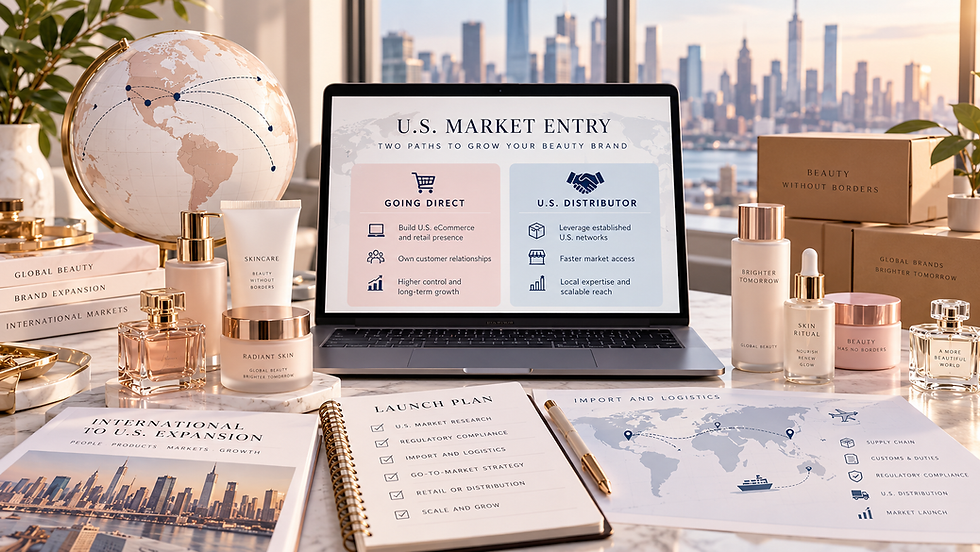
An international beauty brand can enter the U.S. market directly, through a U.S. distributor, or in stages that combine both. Going direct gives the brand control, and also gives it the legal and operational duties. A distributor can take on part of that work if the agreement says so. The right route depends on your resources, your channels, and how fast you want to move.
This guide is written for brand owners and manufacturers outside the United States. It explains what each route involves, where the FDA's rules fall, and when a distributor makes sense. It is general information, not legal advice, so confirm regulatory points with a specialist.
Do You Need a Distributor to Sell in the U.S.?
No. The FDA does not require a brand to use a distributor. Its guidance says a company outside the United States can be the responsible person for a cosmetic product, as long as it is the manufacturer, packer, or distributor named on the label. A brand can also sell direct to consumers or approach retailers itself.
What the FDA does require is that someone completes the regulatory and customs work. Imported cosmetics must meet the same laws as cosmetics made in the United States, according to the FDA's overview for importing cosmetics. Going direct means your company carries that work. Using a distributor means you divide it by agreement.
Why the U.S. Beauty Market Rewards Preparation
The U.S. beauty market is made up of several kinds of sellers. In a 2024 interview with Beauty Independent, the CEO of Italian makeup brand Kiko Milano described department stores, beauty specialists, large e-commerce platforms, local players, and direct-to-consumer sales. He said that selling here takes a different logistics and operations setup than other parts of the world.
The same article shows that brands choose different starting points. Kiko Milano said it planned to build awareness through its own online sales first, then add wholesale and e-commerce partners. The article reports that British body care brand Mirror Water, with limited funds, was targeting small specialty retailers and luxury e-commerce sites before larger wholesalers, and its founder called the U.S. launch a huge risk. These are two companies' experiences, not rules, and the interview dates from August 2024.
Option 1: Going Direct
Going direct means your brand, or a U.S. company you set up, handles each step itself. That includes:
Regulatory work: confirming each product is a cosmetic under U.S. law, checking ingredients and color additives, and meeting the duties described on the FDA's MoCRA page, such as product listing, safety records, and adverse event reporting.
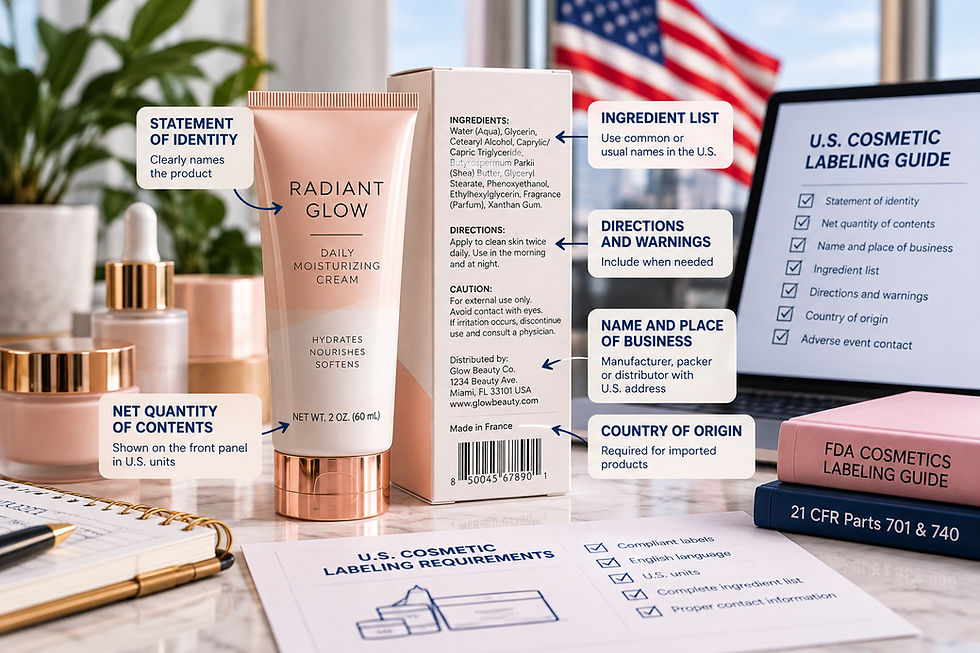
Labels: producing U.S.-compliant labels that include a domestic address, domestic phone number, or electronic contact for adverse event reports.
Import: arranging customs entry for each shipment, for example through a licensed customs broker.
Sales: building relationships with retail buyers or running your own online store and fulfillment.
Service: answering customer questions and complaints, and reporting serious adverse events to the FDA within 15 business days.
The benefit is control over pricing, brand presentation, and customer relationships. The cost is the time, staff, and cash to build every part yourself, and the risk of errors when you are new to the rules.
Option 2: Using a U.S. Distributor
A distributor can take on some of this work, depending on the agreement. Depending on the partner, that can include importing, storing product in the U.S., selling to retailers and e-commerce customers, and sharing what it learns from the market.
The trade-offs are real. The distributor earns a margin, so your pricing has to support both the distributor and the retailer. You give up some control over how and where the product is sold. And the result depends on how much attention your brand receives within the distributor's portfolio. Agreements can also cover territory and exclusivity, which need careful review.
Going Direct vs. Using a Distributor
This table shows how the main tasks can be divided. A distributor handles a task only if the agreement says so.
Task | Going direct | Using a distributor, if agreed |
Customs entry and importer of record | The brand or its U.S. entity, with a customs broker | The distributor acts as importer of record, or works with the brand's broker |
MoCRA duties, such as product listing and adverse event reports | Held by the company named on the label | Held by the distributor if its name is on the label |
U.S. label | The brand makes sure it meets U.S. rules | The distributor may review it before the first order |
Retail and e-commerce relationships | The brand builds each one | The distributor may use its existing relationships |
Storage and fulfillment | The brand arranges a U.S. warehouse or ships from abroad | The distributor may store and ship |
Pricing and brand control | The brand sets prices for each channel | Set by the agreement, with room for the distributor's margin |
Option 3: A Staged Approach
A launch can combine the two routes. A brand can start with online sales to test demand, then add a distributor for retail. It can also begin with a limited territory or channel for a distributor, and expand if results are good. The Kiko Milano and Mirror Water examples above both describe a staged plan, though neither names a distributor.
When a Distributor Makes Sense
These questions can help you decide. They are practical guidance, not fixed rules:
Do you have staff or advisers who can handle FDA duties, customs entry, and U.S. complaints?
Do you already have relationships with U.S. retail buyers or e-commerce platforms?
Can you fund U.S. inventory, marketing, and fulfillment before sales arrive?
Does your channel, such as salons, specialty retail, or online, match what a distributor already serves?
Do you want to move quickly without building a U.S. team first?
If the answers are mainly no, a distributor may reduce your risk and workload. If they are mainly yes, going direct, or a staged mix, may suit you better.
What to Settle Before You Choose a Route
Whichever route you choose, decide these points in writing:
Responsible person: the FDA defines it as the manufacturer, packer, or distributor whose name appears on the label, so the name you print decides who holds the MoCRA duties. See the FDA's guidance on registration and listing.
Label changes: who adapts and pays for U.S. labels. The FDA's Cosmetic Labeling Guide explains the rules.
Importer of record and customs: who files and who pays duties.
Territory and exclusivity: which regions and channels the distributor may sell in, for how long, and what happens if it does not meet targets.
Complaints and recalls: who receives complaints and who acts if the FDA orders a recall.
How to Prepare for Either Route
Choose a first channel and price position that fit your brand.
Confirm that your products are cosmetics under U.S. law, not drugs, and review your claims.
Check ingredients and color additives against FDA rules.
Adapt labels for the U.S., including units, ingredient names, and the adverse event contact.
Assemble your catalog, price list in U.S. dollars, ingredient lists, and safety records.
Build a short list of partners or buyers that already work with brands like yours.
Partnering With Samtastic
Samtastic is a U.S. beauty distribution company that works in haircare, skincare, fragrance, and cosmetics. It is looking to work with brands, manufacturers, and suppliers that want U.S. distribution. Brands can review the categories Samtastic works in on the portfolio page.
If you are weighing a distributor against going direct, start with a short conversation. Introduce your brand to Samtastic through the contact page, with your category, your country, and your product catalog.
Frequently Asked Questions
Do I need a distributor to sell in the U.S.?
No. The FDA does not require a brand to use a distributor, and a company outside the U.S. can be the responsible person for its products. Every product still must meet U.S. cosmetic law, and someone must handle customs entry. A distributor can take on part of that work if the agreement says so.
What is the difference between going direct and using a distributor?
Going direct means the brand handles regulatory work, import, sales, and customer service itself, and keeps control of pricing and customer relationships. Using a distributor divides that work by agreement, and the distributor earns a margin in return. A brand can combine both over time.
Can I start direct and add a distributor later?
Yes. A staged approach is possible, and some brands start with online sales or a small set of retailers before adding partners. Keep your agreements flexible, including territory and exclusivity terms, so a later distributor does not conflict with channels you already serve.
Which U.S. rules apply whichever route I choose?
The FDA states that imported cosmetics must meet the same laws and regulations as domestic ones. That includes safe, properly labeled products and the MoCRA duties of facility registration, product listing, safety records, and adverse event reporting. Customs requirements come from U.S. Customs and Border Protection.

Comments