How to Import Cosmetics to the USA
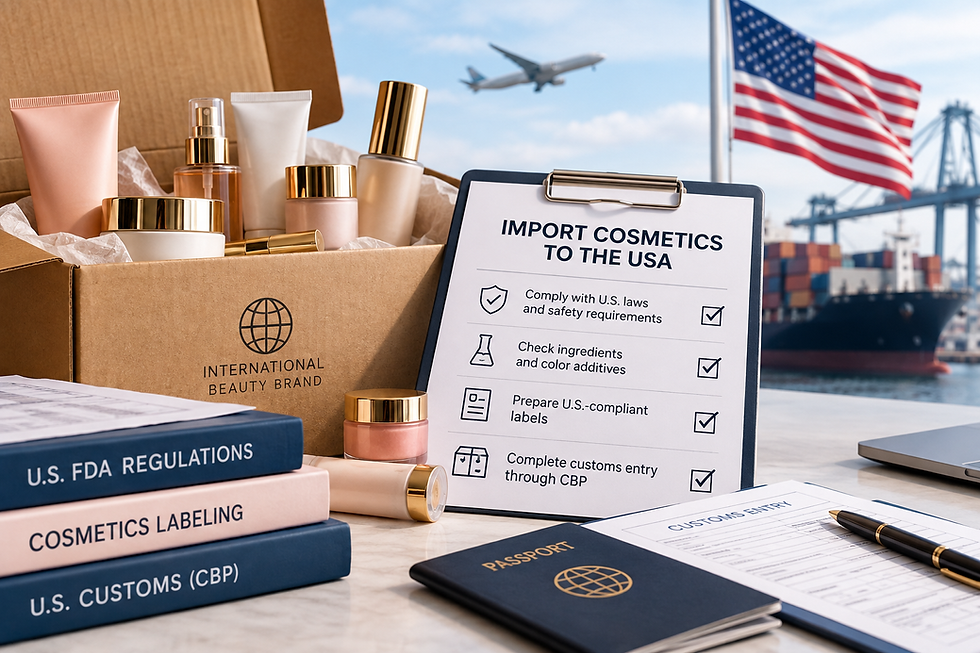
To import cosmetics to the USA, make sure each product meets U.S. law on safety, ingredients, color additives, labeling, and claims, then complete customs entry through U.S. Customs and Border Protection (CBP). The FDA does not pre-approve cosmetics, apart from color additives, but it can refuse entry to products that break the rules.
This guide is written for brand owners and manufacturers outside the United States. It covers the import basics, then shows which tasks the brand prepares and which a U.S. distributor may be able to take on.
Why Import Rules Matter for International Beauty Brands
The U.S. Food and Drug Administration (FDA) states that imported cosmetics must comply with the same laws and regulations as cosmetics made in the United States. Its overview for importing cosmetics is the best place to start.
A product that meets the rules of your home market can still fall short in the U.S. Countries define drugs and cosmetics differently, and the FDA gives sunscreen as an example: some countries regulate it as a cosmetic, while the United States regulates it as a drug.
The cost of a mistake is delay. The FDA states that foreign cosmetics that appear to be adulterated or misbranded may be refused entry, and must then be brought into compliance, destroyed, or re-exported.
Step 1: Confirm the Product Is a Cosmetic Under U.S. Law
U.S. law treats a product as a cosmetic or a drug based on what the product is intended to do. The FDA lists claims that would cause a product to be regulated as a drug, or in some cases as both a cosmetic and a drug:
Hair restoration
Skin protectant
Pain relief
Anti-aging effects that involve the structure or function of the skin
Treatment of acne, dandruff, eczema, or irritated skin
Drugs follow different requirements, including premarket approval. If any product in your range makes claims like these, ask a regulatory specialist to review the product and its label before you plan a shipment.
Step 2: Check Ingredients and Color Additives
Cosmetic products and ingredients, other than color additives, do not need FDA approval before they go on the market. They still must be safe for consumers under labeled or customary conditions of use. Check these points before shipping:
Prohibited and restricted ingredients: the country where you manufacture may not have the same ingredient rules as the United States, so review the FDA's list of prohibited and restricted ingredients against each formula.
Color additives: the FDA allows a color additive only when it has approved it for the intended use, and some additives must come from batches certified in FDA laboratories.
Contamination: microbial contamination can make a product adulterated, even though sterility is not required.
Natural and organic claims: the FDA does not define or regulate these terms. The U.S. Department of Agriculture regulates the use of "organic" for agricultural ingredient marketing.
Step 3: Prepare U.S.-Compliant Labels
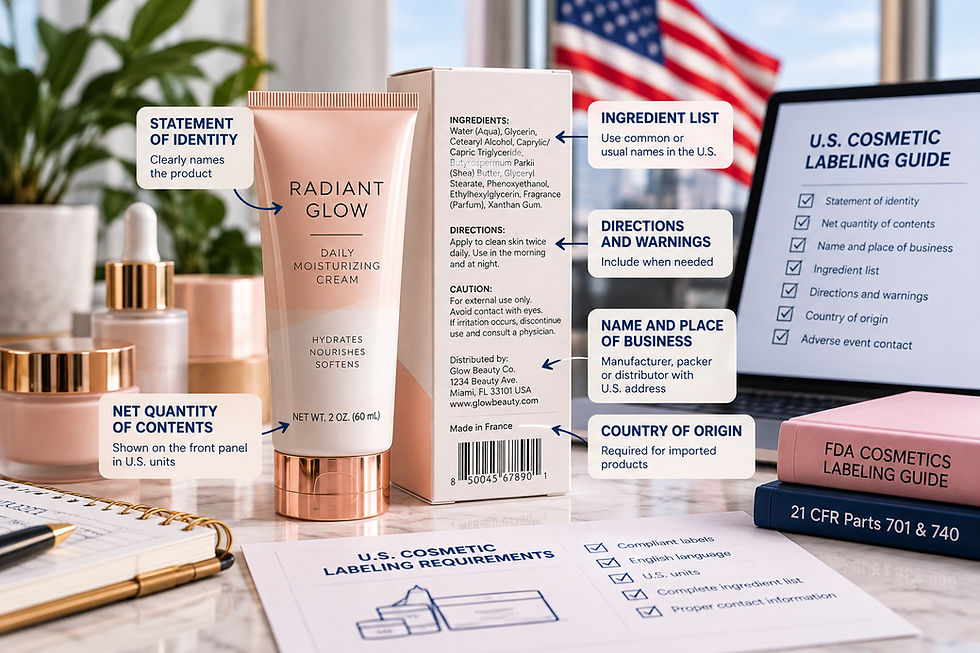
Labeling is one of the reasons the FDA gives for refusing imported cosmetics, including deficiencies in the ingredient declaration. The FDA's importer questions and answers cover the points that matter to international brands:
Label item | What the FDA says |
Language | All required label information must be in English. Spanish is for products marketed only in Puerto Rico. |
Ingredient names | Ingredients must use their common or usual names in the United States. Terms such as "aqua" or "parfum" are allowed only in parentheses after the English names, such as "water" and "fragrance." |
Botanical names | Latin INCI names may follow the common or usual name in parentheses, for example Aloe (Aloe Barbadensis) Extract. |
Color additives | C.I. numbers are acceptable only when they follow the color additive name accepted in the United States. |
MoCRA, covered in the next step, also requires the label to give a domestic address, domestic telephone number, or electronic contact where the company can receive adverse event reports, according to law firm summaries of the act. For step-by-step help with identity statements, warnings, and ingredient lists, use the FDA's Cosmetics Labeling Guide.
Step 4: Understand the MoCRA Duties
The Modernization of Cosmetics Regulation Act of 2022 (MoCRA) added duties for cosmetic companies, including facility registration, product listing, safety substantiation, and adverse event reporting. The FDA explains the act on its MoCRA page.
These duties are separate from the question of who imports the goods. The FDA states that firms importing products considered solely cosmetics are not required to register with the FDA in order to import them. MoCRA registration and listing apply to manufacturing facilities and to the responsible person named on the label, and the act exempts certain small businesses. Law firm summaries add that foreign facilities need a U.S. agent.
Ask a regulatory specialist which of these duties apply to your company. Then agree with your distributor who will handle each one.
Step 5: Arrange Customs Entry
CBP, not the FDA, sets customs requirements. The FDA tells importers with customs questions to contact CBP directly.
In general terms, each shipment needs an importer of record. This is the party responsible for the accuracy of the customs entry and for paying duties. A licensed customs broker can file the entry for the importer of record.
Two practical points help the shipment move:
Duties depend on how the product is classified in the Harmonized Tariff Schedule of the United States. Tariff rules can change, so confirm current duty rates with your broker or CBP before you set export prices.
The FDA compares entry details with its own records, including the declared manufacturer, the declared importer or consignee, and the product description. The FDA states that incomplete or inaccurate information may delay review.
Step 6: Prepare for a Possible FDA Examination
Not every imported cosmetic is inspected or sampled at entry. Products that are not examined must still meet every legal requirement, and the FDA states that a product that was not detained before can still be detained later.
The FDA lists these as some of the reasons cosmetics are refused entry:
Ingredients or contaminants that make the product unsafe
Color additive violations
Prohibited or restricted ingredients used in violation of the rules
Microbial contamination
Labeling violations, including a missing English ingredient declaration
Claims that cause a product sold as a cosmetic to be regulated as a drug
Keep your ingredient lists, safety records, label artwork, and claim support in one place so your broker or distributor can respond quickly if the FDA asks questions.
What a U.S. Distributor Can Handle and What the Brand Prepares
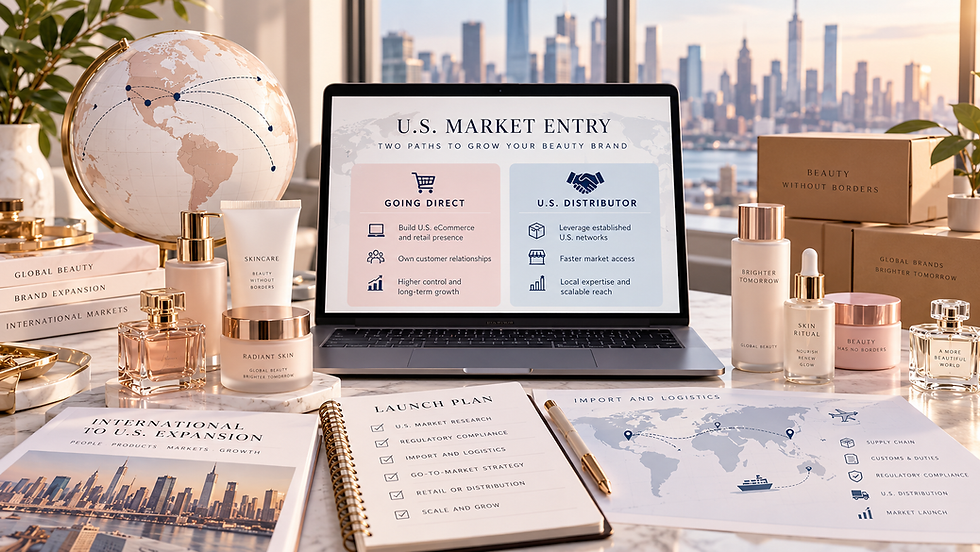
A distributor does not take over these tasks automatically. The distribution agreement sets who does what, so put each task in writing before the first shipment. This table shows how the work can be divided:
Task | The brand prepares | A distributor may handle, if agreed |
Ingredients, safety records, and claims | Prepares and keeps the records | Reviews them before the product goes on sale |
Label artwork | Designs labels that meet U.S. rules | Checks the label before the first shipment |
Importer of record and customs entry | Decides whether to act as importer or name another party | Acts as importer of record or works with the brand's customs broker |
Duties and customs paperwork | Agrees who pays and who files | Pays or files, if the contract says so |
Storage and delivery in the U.S. | Ships product to the agreed U.S. address | Stores the product and delivers it to retail and e-commerce customers |
Contact for adverse event reports | Agrees who is named on the label | Serves as the domestic contact, if agreed |
Partnering With Samtastic
Samtastic is a U.S. beauty distribution company that works in haircare, skincare, fragrance, and cosmetics. It is looking to work with brands, manufacturers, and suppliers that want U.S. distribution. Brands can review the categories Samtastic works in on the portfolio page.
Planning a first U.S. shipment is easier when each side knows who handles each task, so raise import questions early in any distribution conversation. Introduce your brand to Samtastic through the contact page, with your category, your country, and your product catalog.
Frequently Asked Questions
How do I import cosmetics to the U.S.?
Confirm that each product is a cosmetic under U.S. law, check ingredients and color additives, prepare labels that meet U.S. rules, review the MoCRA duties, and arrange customs entry through an importer of record and a licensed customs broker. Contact CBP directly for customs requirements.
Do I need a distributor to import cosmetics?
No FDA rule requires a brand to use a distributor. Every shipment still needs an importer of record and a customs entry, and the brand, a distributor, or another party can fill that role depending on the agreement. A distributor can also help a brand reach U.S. retail and e-commerce channels.
Do I need FDA approval to import cosmetics?
No. Cosmetic products and ingredients, other than color additives, do not need FDA approval before they go on the market. They must be safe and properly labeled, and color additives must be approved for the intended use.
Do I need to register with the FDA to import cosmetics?
The FDA states that firms importing products considered solely cosmetics are not required to register with the FDA in order to import. MoCRA created separate registration and listing duties for facilities and responsible persons, so check which of them apply to your company.

Comments